
A doctor has cleared your loved one for a follow-up appointment, a dialysis session, or a discharge home. They cannot drive, cannot manage stairs, or cannot safely sit upright for the trip. Now you face a practical question that catches many Charlotte families off guard: do you call an ambulance, or do you book a non-emergency medical transport? The two are not interchangeable, and choosing wrong can mean either an unnecessary four-figure bill or, far worse, the wrong level of care for a genuine emergency.
This guide lays out the distinction plainly. An ambulance is an emergency vehicle staffed by EMTs or paramedics, equipped to deliver clinical intervention en route. An ambulette (the term used across the NEMT industry for a wheelchair-equipped van) is a scheduled, non-emergency ride for medically stable patients who need accommodation but not active treatment. Understanding ambulette vs ambulance for non-emergency situations is the single most useful thing you can do before the next appointment lands on the calendar.
If the situation is or could become life-threatening — chest pain, difficulty breathing, stroke symptoms, severe bleeding, or sudden unresponsiveness — call 911. NEMT providers, including ProVital Transit, do not respond to emergencies. When in doubt, treat it as an emergency.
The comparison at a glance
The table below contrasts the two options across the dimensions that actually drive the decision: clinical capability, who each suits, what is included, cost, and how insurance treats them.
| Factor | Ambulance (emergency) | Ambulette / NEMT (non-emergency) |
|---|---|---|
| Primary purpose | Rapid response and treatment for medical emergencies | Scheduled, planned transport for stable patients |
| Staffing | EMTs or paramedics trained in life support | Trained drivers and attendants; no clinical treatment |
| Equipment | Defibrillators, oxygen, cardiac monitors, medications | Wheelchair lifts and securement systems |
| Who it suits | Anyone with an acute, unstable, or potentially deteriorating condition | Patients who are medically stable but need mobility assistance |
| Typical trips | 911 calls, unstable transfers between hospitals | Dialysis, chemotherapy, discharge home, doctor visits, rehab |
| Scheduling | On demand, immediate dispatch | Booked in advance, often round-trip |
| Relative cost | Substantially higher; emergency rates plus mileage | Markedly lower; flat or mileage-based non-emergency rates |
| Insurance handling | Covered when medically necessary as emergency care | Often covered by Medicaid / managed-care plans with prior authorization |
As one industry overview puts it, the core difference is not the van but the level of care: an ambulance carries emergency medical capability, while an ambulette provides safe, assisted transport without clinical intervention (see this ambulette vs ambulance breakdown).
Choose an ambulance when care can't wait
The deciding factor is whether the patient may need medical intervention during the trip. An ambulance is the correct — and only safe — choice when:
- The condition is acute, unstable, or could deteriorate quickly
- Continuous monitoring, oxygen titration, or medication may be required en route
- A clinician has ordered emergency-level transport between facilities
- You are responding to a sudden event and dialing 911
In these cases, cost should not enter the calculus. The value of an ambulance is the paramedic in the back, not the ride itself. Booking NEMT for a patient who needs that level of care is unsafe and, in practice, no reputable provider will accept the trip.
Choose an ambulette (NEMT) when the trip is planned and the patient is stable
Most recurring medical travel is not an emergency at all. It is a standing dialysis schedule, a course of chemotherapy, a discharge back home, or a specialist visit across town. For a medically stable patient who simply needs help with mobility, an ambulette is the appropriate, comfortable, and far more economical option.
Within NEMT, the right vehicle depends on the patient's mobility:
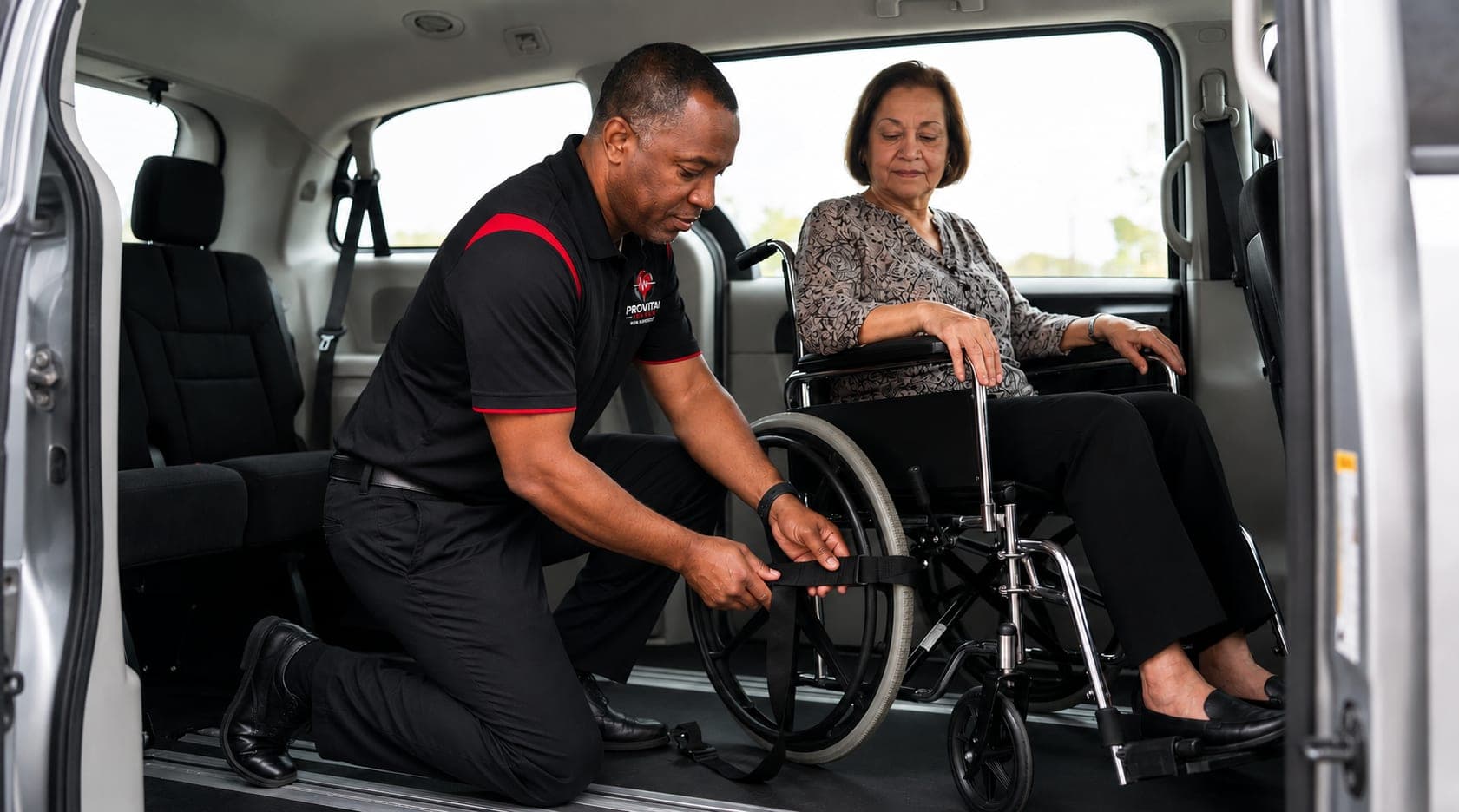
- Wheelchair van — for patients who use a wheelchair or cannot safely transfer into a standard car seat. Our wheelchair transportation uses lifts and four-point securement so the rider stays in their own chair throughout.
The question is rarely "ambulance or van." It is "does this patient need treatment during the ride, or just safe, dignified transport to it?"
"Do I need an ambulance or a wheelchair van?"
A simple test: if the patient is stable and the trip is on the calendar, you almost certainly do not need an ambulance. A wheelchair van suits riders who can be transported seated in their wheelchair without medical supervision. Reserve the ambulance for anyone who must stay reclined on a stretcher, or whose condition could change during the trip.
The cost and insurance difference
This is where the choice has real financial weight. Ambulances bill at emergency rates designed to cover paramedic staffing and life-support equipment, and those charges are considerably higher than non-emergency transport. NEMT services, by contrast, are priced for planned, stable trips — typically a base rate plus mileage — and come in at a fraction of an ambulance bill (a useful primer on NEMT types and costs is available from this NEMT 101 guide).
Coverage follows the same logic. In North Carolina, NC Medicaid includes non-emergency medical transportation as a covered benefit for eligible members traveling to covered services, generally arranged in advance and often requiring prior authorization through the member's plan or county. Emergency ambulance transport is covered when it is medically necessary. The practical implications:
- Using an ambulance for a routine, non-emergency trip risks a large out-of-pocket bill if it is deemed not medically necessary.
- Booking NEMT for a covered appointment may cost the patient little or nothing once authorization is in place.
- Always confirm benefits and authorization requirements with the patient's specific plan before the trip.
Before booking, have the patient's plan information ready and ask your provider whether prior authorization is needed. Throughout Charlotte, NC and the surrounding metro, scheduling a day or two ahead gives time to confirm coverage and lock in the right vehicle.
Making the call
Strip the decision down to one question: does the patient need medical care during the journey? If yes — or if the answer might change before they arrive — that is an ambulance, and for a sudden emergency it is 911. If the patient is stable and the trip is planned, an ambulette gives you safe, accommodating transport at a far lower cost, with a strong chance of insurance coverage.
For non-emergency wheelchair and ambulatory trips across the Charlotte metro, ProVital Transit can help you confirm the right level of service and coordinate scheduling so the only thing left to think about is the appointment itself.