Booking a ride to dialysis or a specialist should not require a degree in disability law. Yet the words that describe a safe wheelchair-accessible trip — securement, lift, tie-down, door-through-door — rarely get explained to the people who depend on them. This glossary translates that vocabulary into plain English so you can tell a compliant service from a careless one, and so you understand what federal law and a reputable provider actually owe you.
A quick note on scope: this covers wheelchair accessible medical transportation under the ADA, which is non-emergency by definition. If someone is in medical distress, call 911 — NEMT is for scheduled, stable trips like clinic visits, infusions, and discharges, not emergencies.
The Americans with Disabilities Act (ADA) sets a national floor for accessibility. North Carolina providers must meet it, and many Medicaid transportation rules layer additional safety requirements on top. When a term below references "what you're owed," it reflects that baseline — not a courtesy a driver can skip on a busy day.
The Vehicle: What Gets You In and Out
WAV (Wheelchair-Accessible Vehicle)
A van or vehicle modified to carry a passenger who remains seated in their wheelchair. A true WAV has a lift or ramp, a lowered or raised roof for clearance, and anchor points built into the floor. A regular minivan with the back seats folded down is not a WAV, even if your chair physically fits inside.
Lift vs. Ramp
Both solve the same problem — getting a seated rider from sidewalk to vehicle — but differently. A lift is a powered platform that raises and lowers vertically, common in full-size vans and useful at curbs of any height or for heavier power chairs. A ramp is an inclined surface the chair rolls up, typically in lowered-floor minivans. Ramps are quieter and have fewer moving parts; lifts handle greater weight and steeper boarding. Neither is "better" universally — the right choice depends on your chair's weight and your boarding spot.

The Critical Part: Securement
Securement
The process of locking both the wheelchair and the rider in place so neither moves during transit. This is the single most important safety step, and it is the one corners get cut on most often. A chair that rolls, tips, or slides in a sudden stop turns a routine drive into an injury. Securement is not optional politeness; it is the standard of care.
Four-Point Tie-Down
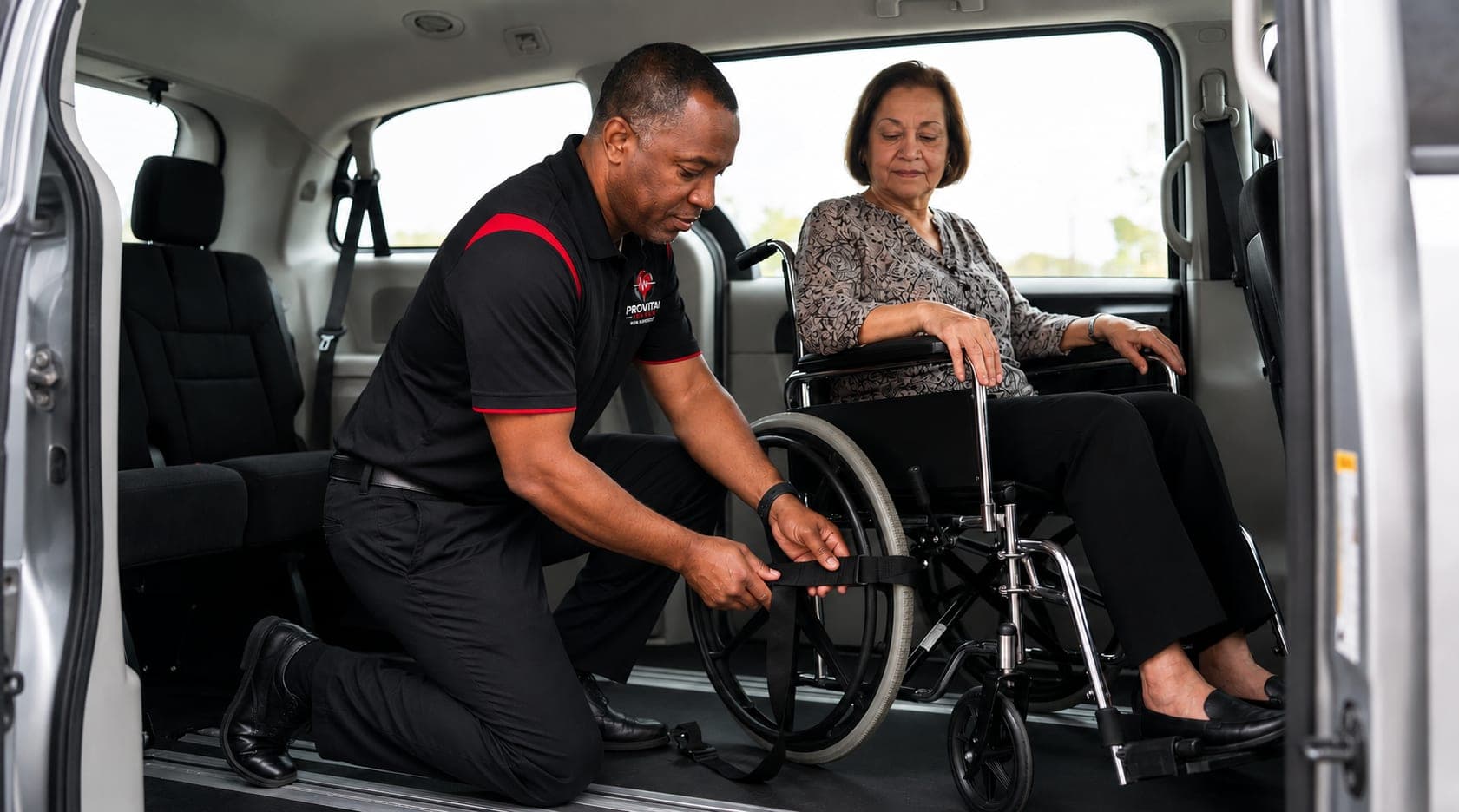
The widely accepted method for securing a wheelchair: four separate straps anchor the chair's frame to floor tracks — two at the front, two at the rear — pulling in opposing directions so the chair cannot shift forward, back, or sideways. Reputable services treat four points as the minimum, not a suggestion. If a driver clips only one or two straps "because it's a short ride," that is a red flag.
Occupant Restraint (Lap-and-Shoulder Belt)
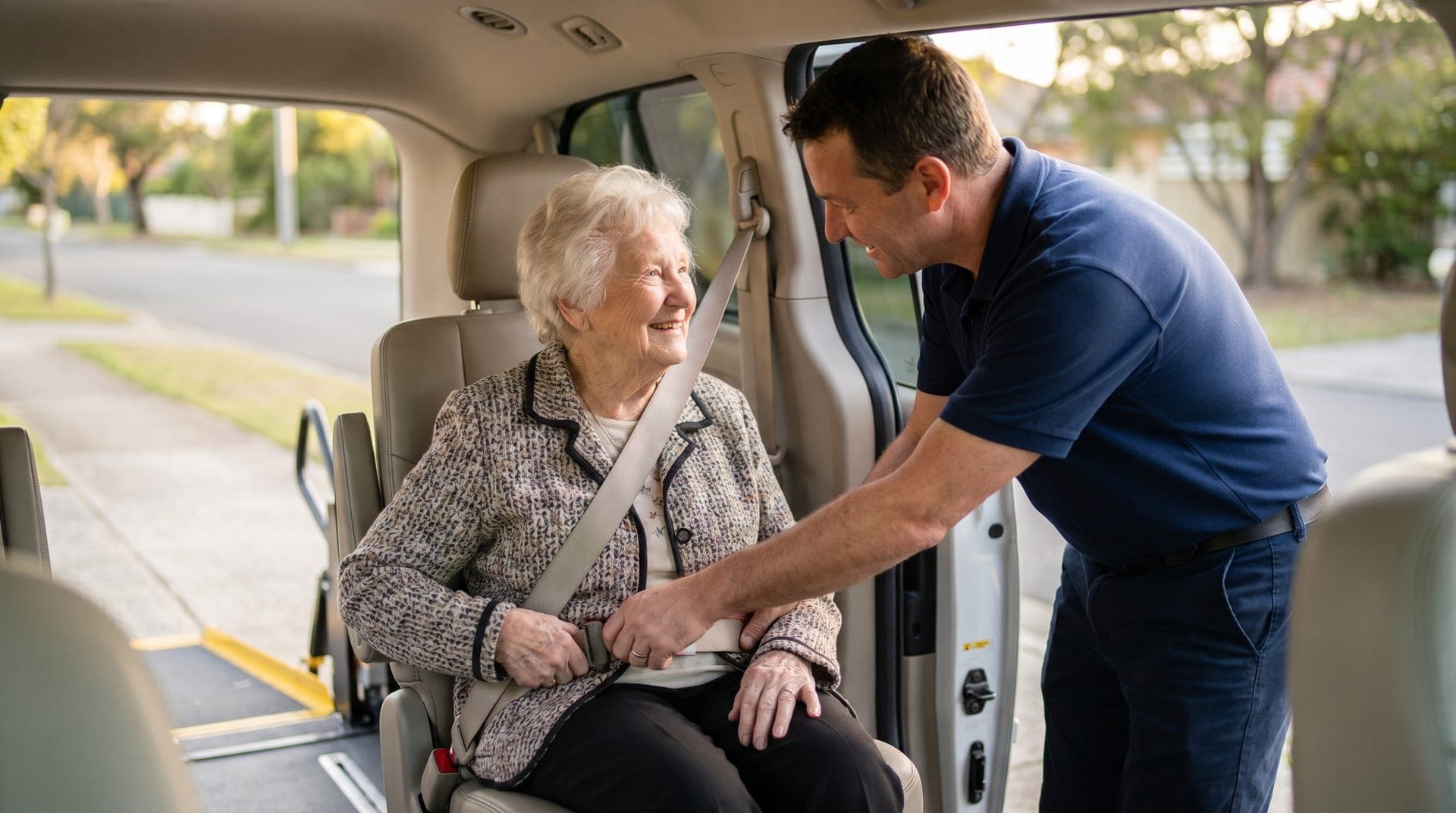
Separate from the four-point tie-down that holds the chair, the rider needs their own lap-and-shoulder belt. Securing the chair without belting the person leaves the most fragile part — the human — unprotected. A complete securement is the chair anchored at four points and the occupant belted.
Are wheelchair vans required to secure my chair? Yes. Properly equipped WAVs are built with securement systems, and a trained driver is expected to use them on every trip. A service that waves off tie-downs to save a few minutes is not delivering compliant transport — it is gambling with your safety.
The Service Level: How Far the Help Goes
Curb-to-Curb
The driver brings the vehicle to the curb outside your origin and drops you at the curb of your destination. You (or someone with you) handle getting from the door to the curb. This works for riders who are independent up to the vehicle but is rarely enough for someone using a wheelchair alone.
Door-to-Door
A step beyond curb-to-curb: the driver comes to the building's outer door to meet you and escort you to the vehicle, and does the same at the destination. The driver does not, however, enter your home or the clinic interior.
Door-Through-Door
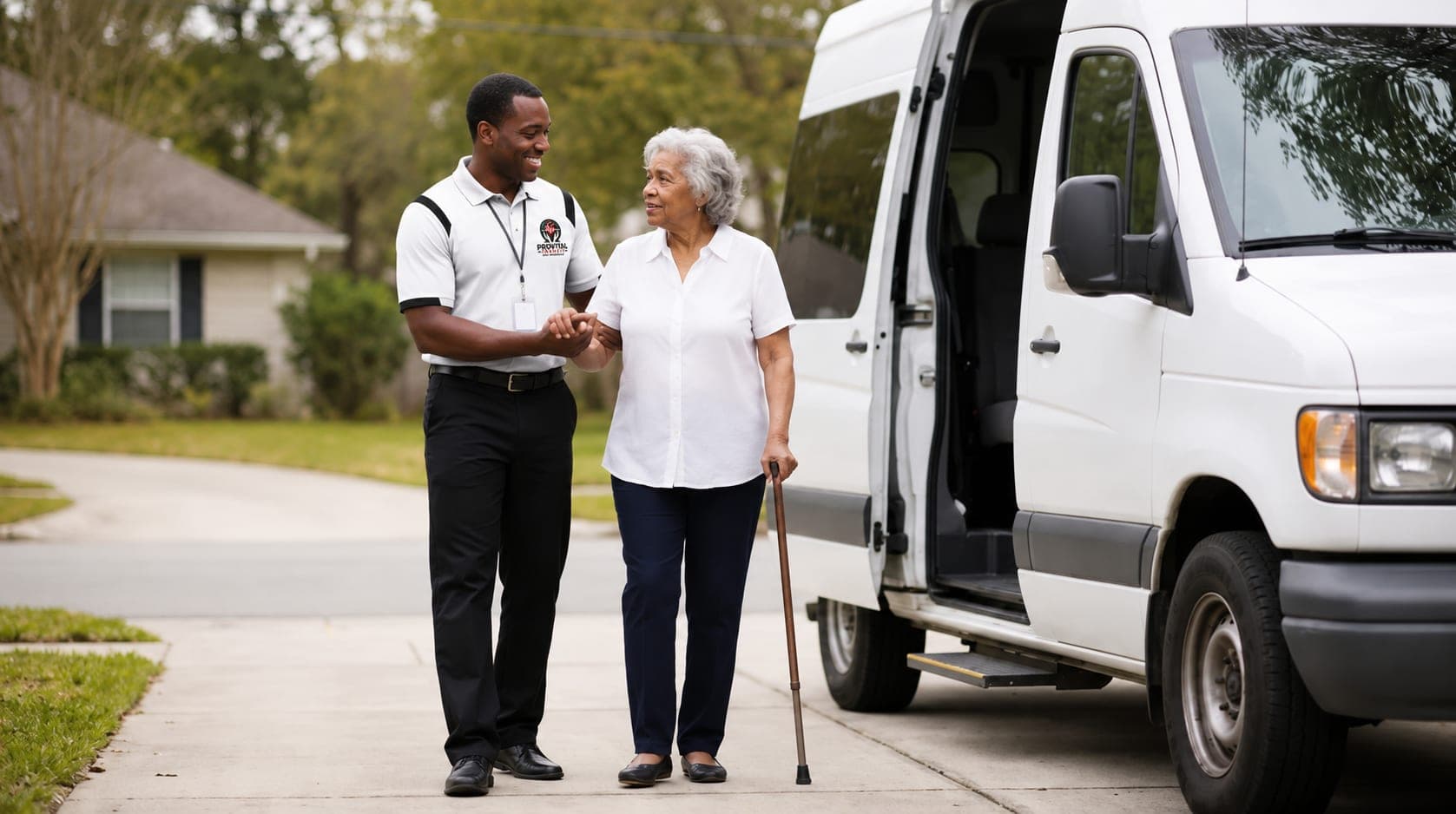
The highest standard of assistance. The driver helps you from inside the origin — your living room, a waiting area — all the way to inside the destination. For many wheelchair users, especially those traveling without a companion, door-through-door is the difference between a trip that works and one that strands them at a threshold they cannot cross alone.
When you book, name the service level out loud. "Curb-to-curb" and "door-through-door" describe very different rides — assuming the wrong one is how people get left at the door.
Knowing the Right Ride — and Your Rights
Ambulatory vs. Non-Ambulatory
An ambulatory rider can walk, possibly with a cane or walker, and transfer into a standard seat. A non-ambulatory rider stays in their wheelchair for the trip and needs a WAV. Knowing which term applies to you prevents the wrong vehicle from showing up — a frustratingly common scheduling error. If your needs fall between transport types, our guide Ambulette or Ambulance? How to Choose the Right Ride breaks down where wheelchair transport ends and medical transport begins.
What Makes Transportation ADA Compliant
Compliance is more than owning an accessible van. A compliant service combines: a properly equipped WAV with a working lift or ramp; functional four-point securement plus occupant restraints used on every trip; drivers trained in safe boarding and securement rather than left to improvise; and accommodation of mobility devices and service animals without surcharge or refusal. Miss any one of these and the "accessible" label is hollow.
Spot a safe service in seconds
- Securement is non-negotiable — four-point tie-down for the chair plus a belt for you, every single trip.
- Match the vehicle to your chair — confirm it is a true WAV with the lift or ramp your power chair needs.
- Name your service level — curb-to-curb, door-to-door, and door-through-door are not interchangeable.
- Ask how drivers are trained — a vague answer about securement is your cue to look elsewhere.
Accessible Medical Transport Rights in the Charlotte Metro
Across charlotte nc and the surrounding Mecklenburg County communities, riders are entitled to refuse a vehicle that lacks proper securement, to request the level of assistance their condition requires, and to travel with their own mobility equipment. If you rely on Medicaid-funded trips, those state rules reinforce the ADA baseline rather than replace it. For a broader primer on transport types and costs, the industry overview NEMT 101 is a useful starting point.
The vocabulary above is your leverage. A provider that can clearly explain its securement procedure, name its service levels, and match the right WAV to your chair is showing you the same care it will show on the road. If you are arranging wheelchair transportation in the Charlotte area, use these terms to ask sharper questions — the answers tell you everything about who is actually safe to ride with.